Solid-state battery announcements describe different materials, cell designs and stages of manufacturing. They should not be combined into one imaginary “2026 battery” with doubled energy density, unlimited temperature tolerance and no fire risk.
For a product team, the useful question is whether a specific available cell meets the device’s electrical, mechanical and safety requirements under the expected conditions.
Name the Chemistry and the Stage
QuantumScape describes its approach as solid-state lithium-metal technology with an anode-free manufacturing design. That is different from the previous article’s claim that the same development unlocked pure silicon anodes. QuantumScape’s technology overview explains the architecture.
The company announced QSE-5 B1 sample shipments in October 2025. Sample delivery and a vehicle demonstration are development milestones; they do not establish that every relevant vehicle or wearable has moved to mass-produced cells. The shipment announcement identifies the stage.
Toyota and Idemitsu’s collaboration announcement set a 2027–2028 commercialization target followed by further mass-production work. It is a stated plan, not evidence of universal 2026 availability. Toyota’s announcement gives that context.
Compare Like with Like
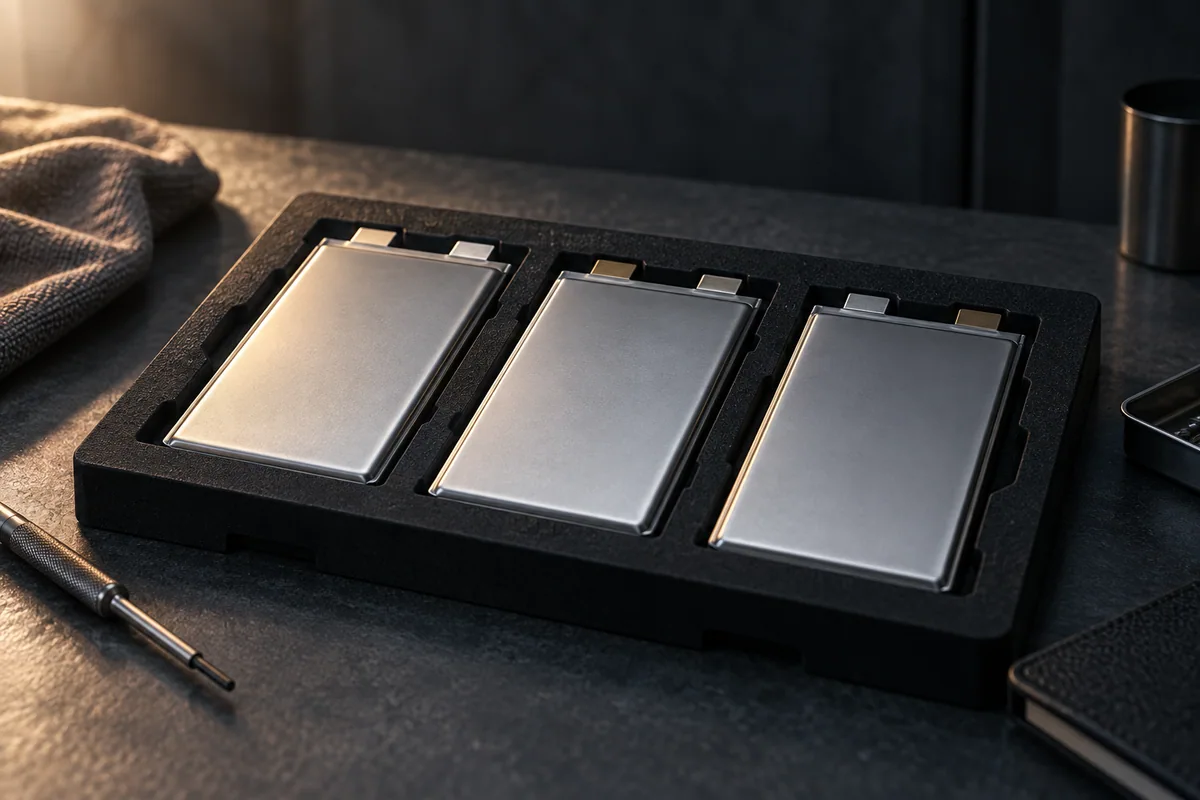
For its QSE-5 B sample, QuantumScape reported 301 Wh/kg and 844 Wh/L under specified conditions, including a C/5 discharge rate and 25°C temperature. These are cell figures with a defined measurement basis. The B-sample explanation discusses the conditions.
Keep gravimetric and volumetric energy density separate. Also distinguish a cell from the complete pack, which includes connections, control electronics and other required structure.
A useful comparison records:
- The exact cell and whether the figures are measured or projected.
- Discharge conditions and the usable state-of-charge window.
- Cycle-test conditions and the remaining capacity criterion.
- Mechanical and thermal requirements.
- Sample availability, qualification and production status.
The phrase “solid-state” alone is not a safety certificate. A particular design may address specific failure mechanisms, but “zero fire risk” requires evidence that a category label cannot supply.
Keep the Software Energy Budget
For an illustrative sensor, average power depends on the energy spent sampling, computing and transmitting, plus sleep consumption. A larger battery changes the budget; it does not make those operations free.
Batching transmissions, avoiding unnecessary wakeups and making sampling frequency configurable remain useful design choices. Measure a representative workload on the actual device, including poor radio conditions and cold starts.
Do not derive a wearable’s runtime from an automotive cell announcement. The form factor, discharge profile, usable capacity and surrounding electronics differ.
The engineering opportunity is to make power assumptions explicit and revisable. Better cells can improve a product, while disciplined software and system testing still determine how that capacity becomes useful runtime.

Sardar Mukhshaf
Full-Stack & DevOps Engineer
I build scalable web applications, secure backend systems, and production-ready cloud infrastructure. My engineering focus spans interface design, API architecture, deployment pipelines, and observability. Follow for more deep dives into system architecture, performance engineering, and emerging technologies.
More from the practice
Keep the useful ideas close.
Follow new articles with your preferred RSS reader.
Open the RSS feed ↗